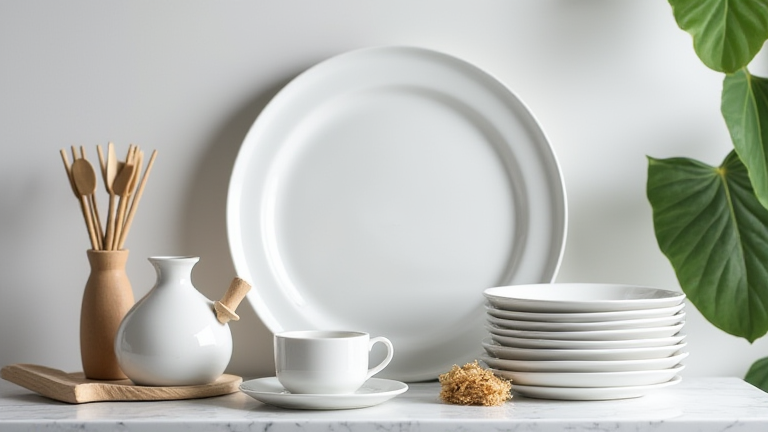
TL;DR: To buy quality porcelain, check for translucency, ring clarity, and a hard, vitrified body—then verify the manufacturer’s markings and firing temperature. Prioritize pieces with no crazing, chipping, or warping, and match the porcelain type (hard-paste vs. bone) to your intended use.
1. Know Your Porcelain Types
Start by distinguishing hard-paste porcelain (fired at 1,300–1,400°C, dense and chip-resistant), soft-paste (lower firing, more fragile), and bone china (contains bone ash, extra white and translucent). For daily use, choose hard-paste or bone china; for display, soft-paste is acceptable.
If you want to dig deeper, check out our guide on Porcelain Buying Guide: Top Tips for Modern Lifestyles.
2. Test Translucency
Hold the piece up to a bright light. Quality porcelain should show a soft, warm glow—especially at the rim or thinnest points. If it’s opaque, it’s likely stoneware or low-fired earthenware, not true porcelain.
3. Check the Ring
Gently tap the rim with a fingernail or a metal utensil. A clear, bell-like tone that lingers for 2–3 seconds indicates high-density, well-vitrified porcelain. A dull or thudding sound suggests under-firing or internal cracks.
4. Inspect for Crazing
Crazing—fine spiderweb cracks in the glaze—weakens the piece and harbors bacteria. Run your fingernail across the surface; if it catches on any line, reject it. Hairline cracks at the base are deal-breakers, even if hidden.
5. Examine the Foot Rim
Flip the piece over. The unglazed foot rim (where it touches the table) should be smooth, perfectly flat, and free of rough grit. A rough or uneven foot means poor finishing and potential wobbling.
6. Verify the Firing Mark
Look for a factory backstamp—underglaze blue or impressed. Reputable makers (Meissen, Royal Copenhagen, Noritake) stamp clearly. If the mark is painted on top of the glaze, it’s often a low-quality tourist piece. Also, check for a “hard-paste” or “bone china” notation.
7. Test for Warping
Place the piece on a flat, level surface. It should not rock. For plates, place a straightedge across the rim—gaps greater than 1mm indicate warping, which leads to uneven stacking and cracking in microwaves.
8. Look at the Glaze Surface
Quality glaze is glossy, smooth, and free of pinholes, bubbles, or bare spots. Run your thumb across the surface—it should feel slick, not tacky. Matte finishes are fine, but they must be uniform, not blotchy.
9. Check Weight and Thickness
Quality porcelain feels surprisingly light for its size (due to vitrification), but the walls should be even—not too thin at the base or thick at the rim. Hold it to the light; uneven thickness shows as darker or lighter patches.
10. Buy from Specialists, Not Generalists
Purchase from dedicated porcelain dealers, auction houses, or direct manufacturer outlets. Avoid generic home stores unless you can verify the firing temperature and clay body. Ask for a certificate of authenticity or a catalog year for vintage pieces.
FAQ
Q: Is bone china always better than hard-paste porcelain?
A: Not always—bone china is more translucent and chip-resistant, but hard-paste porcelain is harder and more scratch-resistant. For everyday dinnerware, bone china wins; for collectible art pieces, hard-paste is preferred.
Q: How can I tell if a piece is antique porcelain without a mark?
A: Look for
Leave a Reply